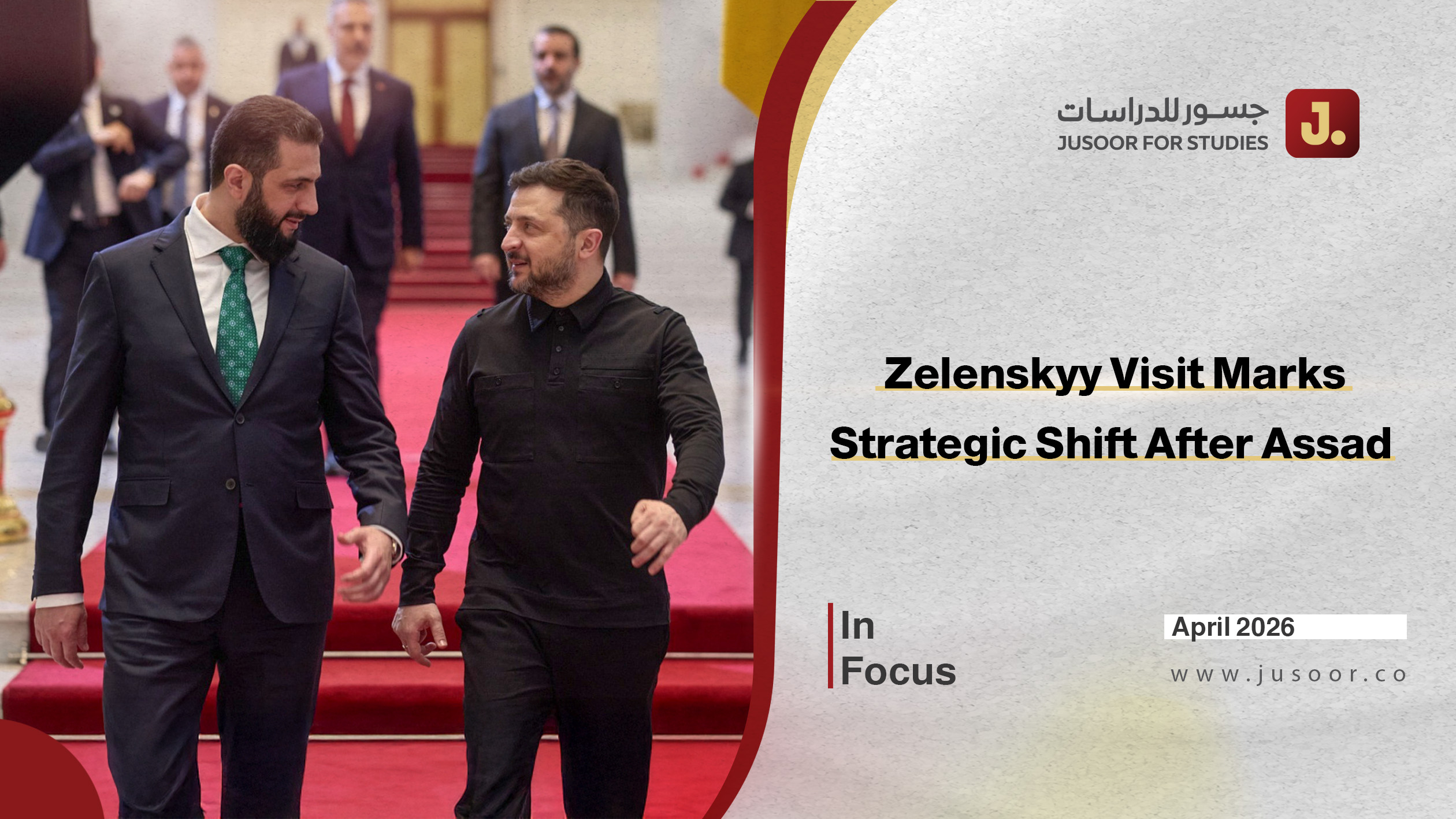
Zelenskyy Visit Marks Strategic Shift After Assad
On April 5, Ukrainian President Volodymyr Zelenskyy met Syrian President Ahmed al-Sharaa in Damascus, his first visit since they formally restored their countries’ diplomatic relations with a meeting on the sidelines of the UN General Assembly in September. Ukraine, with an eye Russian influence in the region, had sent its Foreign Minister to Damascus shortly after the toppling of the Assad regime in December 2024, to meet the new Syrian leadership and explore how to cooperate and reduce Moscow’s clout.
Zelenskyy arrived in Damascus with a delegation including Foreign Minister Andrii Sybiha, Chief of the General Staff Andrii Hnatov, and Secretary of the National Security and Defense Council Rustem Umerov. They also met Syrian Foreign Minister Asaad Al-Shaibani, Defense Minister Major General Marhaf Abu Qasra, and army chief Major General Ali al-Naasan.
The visit was coordinated with Ankara, which appears to have played a significant role in setting its agenda. The Ukrainian delegation traveled on to Türkiye the following day, aboard an official Turkish plane and accompanied by Foreign Minister Hakan Fidan, who also attended the meeting between the two presidents.
The visit came in the shadow of the US-Israeli conflict on Iran, which has triggered strategic realignments and economic consequences due to the disruption of energy and oil supplies, as well as security implications concerning the military use of Syrian airspace, which has been repeatedly violated by drones crossing in from Iraq. Syria also faces military threats along its borders with Lebanon and Israel.
As Ukraine continues to fight its own grinding war, it is striving to demonstrate its political and security influence internationally and in the Middle East, including by showcasing its ability to operate in Russia’s areas of influence and to challenge Moscow. It is also seeking to follow through on a December 2024 statement by its Minister of Agriculture, who said his country was ready to supply Syria with food after the fall of the Assad regime and the suspension of Russian aid. This was also a response to Moscow’s attempts to persuade the US to abandon Ukraine in exchange for halting Russian intelligence support to Iran.
Kyiv is deeply involved in developing an emerging regional security and defense system, built on close integration and complementarity between Ukraine, Türkiye, Saudi Arabia, and Syria. Ukraine, with its grim experience of drone warfare, is helping provide countermeasures against the devices, including electronic jamming devices and missile-based systems. To this end, in March it sent specialized teams to five countries—Saudi Arabia, the UAE, Qatar, Kuwait, and Jordan—to help them intercept Iranian drones and to advise on air defense measures.
After it won its independence with the breakup of the Soviet Union, Ukraine retained most of the military infrastructure on its territory, including aircraft, tank, and artillery factories. Its technical personnel are able to repair Russian-made military equipment, unlike their counterparts in Syria, given the country’s stagnant relationship with Russia. Ukraine also has significant intelligence capabilities. Furthermore, its military use both Russian and Western weaponry, as does Syria’s. This situation lends itself to military and security cooperation between the two countries. Historically, many Syrian officers have completed advanced military courses at the Odessa Military Academy.
Its own needs aside, the Syrian government’s approach to relations with Ukraine is heavily influenced by Turkish demands. As Damascus strives to develop military ties with Ukraine according to its needs, it is also seeking to avoid jeopardizing its relationship with Russia. This reflects a general policy of expanding and balancing its international partnerships without engaging in confrontations with any side, in order to support Syria’s post-conflict recovery, development and stability.