UN Removes HTS from its Sanctions List
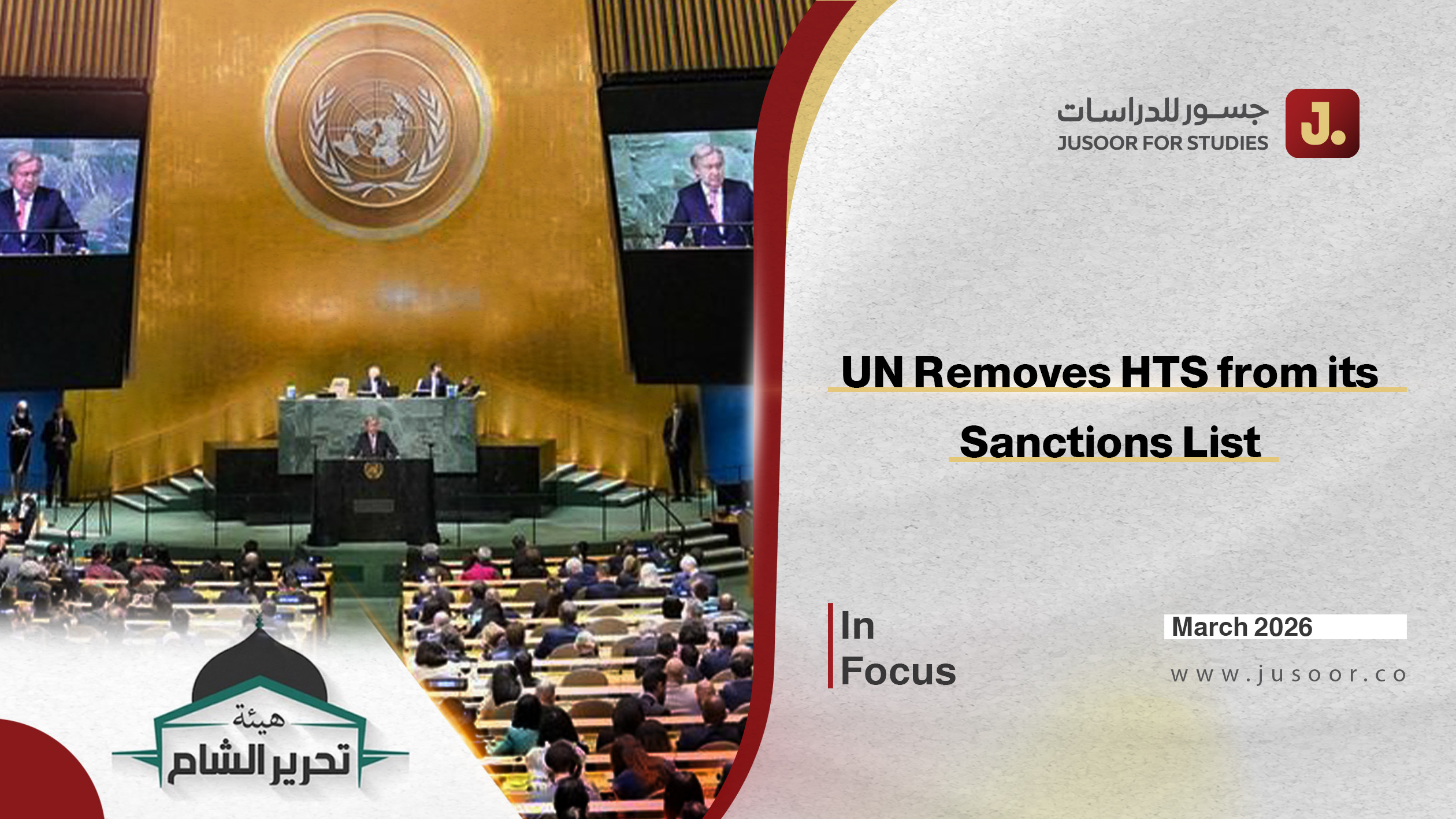
On February 27, the United Nations Security Council removed Syrian militant group Hayat Tahrir al-Sham from its sanctions list, lifting an asset freeze, travel ban, and arms embargo imposed in 2024 under UNSC Resolution 2734.
The Security Council Committee’s decision followed a string of resolutions* concerning the Islamic State group, Al-Qaeda, and associated individuals and groups. The committee, comprising all 15 members of the Council, had added HTS to a list including all individuals and entities subject to measures imposed by the Security Council on May 14, 2014, under the name “Jabhat al-Nusra for the People of the Levant.” The name had been included on the so-called “Consolidated List” from May 30, 2013, as an alias for global jihadist network Al-Qaeda.
The removal of HTS from the sanctions regime had been expected since the U.S. scrapped the group’s designation as a terrorist organization on July 8 last year. The latest move appears to have been based primarily on documents submitted by the Syrian government confirming that HTS was a “dissolved entity,” had not formed a replacement entity under another name, and no longer posed a terrorist threat. These documents echo the Security Council committee’s summary justifying the group’s inclusion on the UN list, which had not cited any activities attributed to HTS since 2017.
Numerous U.S. officials have argued that removing HTS from the list supports U.S. national security and foreign policy objectives, including key goals such as ensuring Israel’s security, concluding security agreements and a Syrian and regional peace deal with Israel, severing Syria’s ties with Iran, limiting Russia’s presence and influence, and preventing Chinese expansion in the region.
These objectives were further emphasized in a report on Operation Inherent Resolve (OIR)—the international war against the Islamic State (IS)—to the US Congress, covering the period up to the end of 2025. The “Lead Inspector General” who wrote it noted that the U.S. government’s objectives also include normalizing bilateral relations with the Syrian government, integrating Syria’s minorities into government security forces and civilian administration structures, strengthening U.S. strategic and commercial interests in Syria by expanding access for U.S. companies, denying IS the conditions it would need to regroup and threaten the country again, and reintegrating the residents of al-Hol camp into their communities.
The removal of HTS from the list indicates the stability of Syrian-American relations, in light of understandings on numerous domestic and foreign issues. Domestically, the two sides continue to coordinate on northeastern Syria and Suwayda, while internationally, they are addressing the Israeli and Iranian files. Furthermore, the agreement of both Russia and China to the cancellation suggests that Syria’s relations with both Moscow and Beijing are also progressing positively, addressing Russia’s concerns regarding the Tartus and Hmeimim bases, and China’s concerns over fighters affiliated with the East Turkestan Islamic Movement.
The reclassification of HTS strengthens the legitimacy of the Syrian government and acknowledges the change in HTS’s behavior and its final dissolution. This is likely to be reflected in support and arms supplies to the new Syrian army, paving the way for lifting the remaining Western sanctions on Syria and thus allowing for an inflow of funding and investment. It also contributes to achieving the economic and security stability that could encourage the return of Syrian refugees to their country.
Moving forward, the U.S. is likely to push forward efforts to remove Syria from the list of state sponsors of terrorism. This point was highlighted in the report on Operation Inherent Resolve, which confirmed that this designation restricts U.S. foreign aid, prohibits defense exports and sales, and limits exports of dual-use goods, among other restrictions. The Combined Joint Task Force – Operation Inherent Resolve (CJTF-OIR) also confirmed that the designation impacts any potential support the force could provide to the Syrian government as a partner in counterterrorism operations.
*UNSC Resolutions 1267 (1999), 1989 (2011), and 2253 (2015).