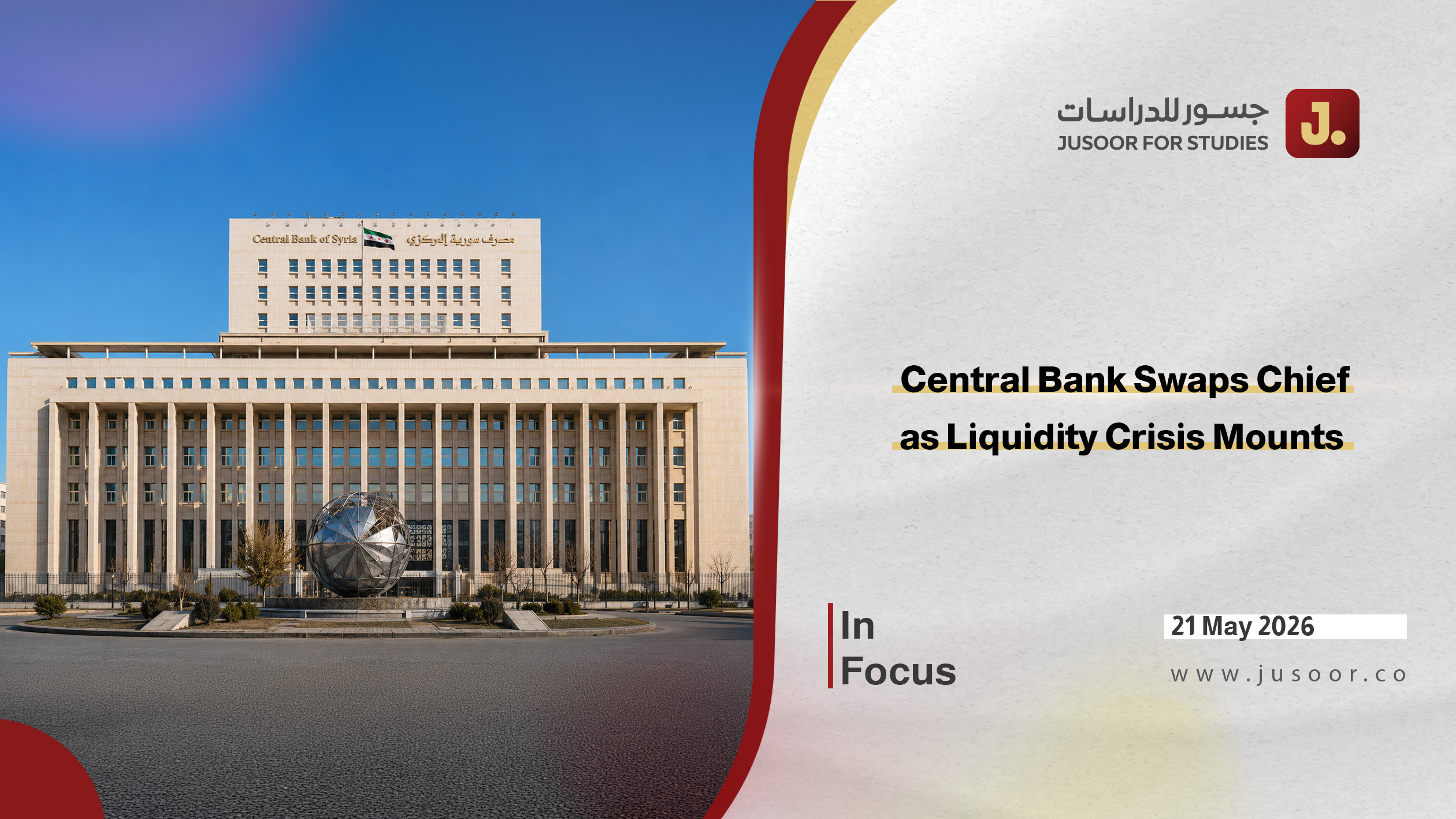
Central Bank Swaps Chief as Liquidity Crisis Mounts
On May 15, the Syrian Foreign Ministry abruptly replaced Central Bank Governor Abdul Qader Hasriya, appointing him instead as ambassador to Canada after a year in the job. Shortly afterwards, President Ahmed al-Sharaa appointed Mohammed Safwat Raslan to take his place, in the context of Syria’s mounting monetary and economic challenges.
Under Hasriya, the Central Bank had pursued a monetary policy focused on managing inflation and liquidity rather than traditional tools related to interest rates, given the limited effectiveness of monetary policies in an economy marked by unregulated cash flows and weak confidence in the banking sector.
This strategy was aimed at rebuilding confidence in the Syrian pound through quantitative tools and strict regulatory measures, most prominently the launch in January of a currency replacement program involving the removal of two zeros from new banknotes and printing a quantity equivalent to 42 trillion lira in the old currency, or some 13 billion individual coins and banknotes.
This process has been hobbled by major delays. By mid-March, the amount of currency replaced had not exceeded 40% of the total money supply, despite successive regulatory measures by the central bank. Most recently, it pushed back the deadline for completion of the process to the end of June, despite the urgent need to restore monetary stability and ensure liquidity in the market. The prolonged existence of two currencies side by side has sowed confusion, opened the door to speculation and led to greater reliance on the parallel market.
These delays can be attributed to technical and logistical factors related to the processes of printing and supply, and the ill-prepared state of Syria’s banking infrastructure, including ATMs and counting and sorting systems. This is compounded by a liquidity crunch resulting from massive withdrawals of the old currency without a rapid, equivalent injection of the new one. This has impacted market activity and day-to-day liquidity, leading many Syrians to opt for holding dollars or trading on the black market.
The U.S.-Israeli war on Iran has further pressured the Syrian pound’s exchange rate against the dollar, as growing anxiety in the market has pushed up demand for foreign currency. In response, the Central Bank has ordered international money transfer companies to adhere to the official exchange rate, within a price fluctuation margin raised from 15% to 17%. However, the gap between the official rate and the parallel market rate has remained stubbornly high, at some 400 old Syrian pounds, thus strengthening the influence of the black market and parallel exchange rates in determining the real exchange rate.
This coincided with the extension of the currency exchange deadline by a month. This and other measures have pushed those with substantial holdings of the defunct currency to move quickly to convert their savings into dollars or more stable assets. This has placed additional pressure on the pound and reinforced concerns about the future of Syria’s monetary policy and the central bank’s ability to complete the transition without causing further disruption.
Furthermore, the managed unpegging of the pound, which the central bank has pursued due to limited ability to intervene and its lack of foreign currency reserves, has contributed to rising living costs and increased economic and social pressures. This has been exacerbated by the impact of rising oil prices and disruptions to regional supply chains, hitting a Syrian economy which relies on imports for some 85% of consumption. This has further widened the country’s gaping trade deficit and heightened public discontent and resentment.
Shortly before the governor’s replacement, the Central Bank of Syria had launched a comprehensive strategy for 2026-2030, whose key pillars include achieving long-term monetary stability, building a regulated exchange market, developing a digital payments system, and expanding financial inclusion, all in order to rebuild confidence in the banking sector and gradually integrate the Syrian economy into international financial systems.
Replacing the governor of the Central Bank of Syria has far-reaching monetary, economic, and political repercussions. It comes as Syria faces a crisis of confidence in its currency, reflected in multiple exchange rates, a growing informal cash economy, and traditional central bank tools that are increasingly ineffective. The change therefore reflects an official recognition of the pressures facing monetary policy, and an attempt to mitigate the growing economic and social impacts of a collapse in the exchange rate and Syria’s liquidity levels.
That said, a change at the top does not necessarily indicate a radical shift in Syrian monetary policy. The central bank still has limited a limited toolkit at its disposal, due to the fragility of the country’s economic structure, its limite foreign currency reserves, and the complexities of the regional and international environment. Given this situation, confidence remains the key factor in the stability of the Syrian pound, meaning the success of any monetary policy will depend on a coherent economic vision—along with broader reforms that go beyond simply changing personnel, and address the root causes of Syria’s monetary and economic crisis.