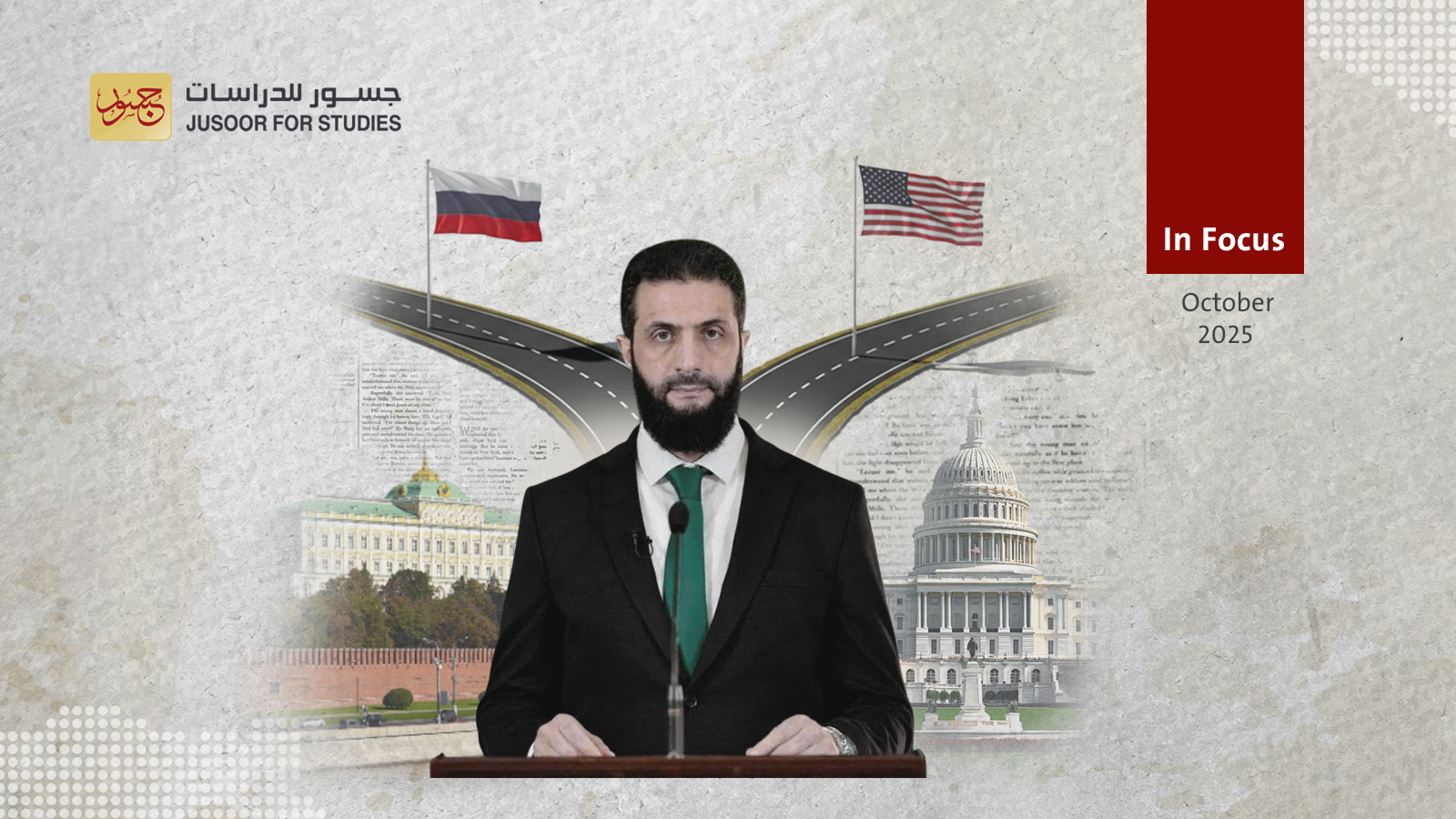
Sharaa Hedges Bets with Visit to Russia
Syrian President Ahmed al-Sharaa met his Russian counterpart Vladimir Putin in Moscow on October 15, during a visit along with a high-ranking Syrian delegation.
Sharaa’s first visit to Russia since taking office was in stark contrast with the vast military and diplomatic efforts Russia had exerted to crush the Syrian revolution and protect the Assad regime—a regime ultimately toppled by forces led by Sharaa, forcing president Bashar al-Assad to flee to Moscow last December.
Sharaa’s visit coincided with the day that had been set for the first Arab-Russian summit, which was postponed as several Arab leaders were preoccupied with implementation of U.S. President Donald Trump’s plan for Gaza. That the Moscow trip went ahead suggests eagerness on Russia’s part to push forward in building its relations with the new Syrian government.
The meeting was the culmination of a string of Syrian-Russian meetings: a visit by a Russian delegation to Damascus headed by Deputy Foreign Minister Mikhail Bogdanov in January; a phone call between Putin and al-Sharaa in February; a message from Putin to al-Sharaa in March; and three subsequent meetings between the two foreign ministers in Antalya, Moscow and New York. These were followed by a visit by a Syrian delegation to Moscow in July, including ministers and officials from the Ministries of Foreign Affairs, Defense, Security, and Intelligence, then a visit by Russian Deputy Prime Minister Alexander Novak to Damascus at the head of a high-level delegation in September, and finally the visit of a Russian military delegation to Damascus at the beginning of October.
In Moscow, Russia gave Sharaa a warm welcome, clearly seeking to send a message that it is a true friend of the Syrian state and that it is committed to defending Syria’s interests at international forums—as it has done for the past 80 years. Finally, it sought to portray Putin as a trustworthy and reliable president, unlike his volatile U.S. counterpart.
In fact, from the early days following Syria’s liberation, both sides have seemed eager to resume new relations, turning the page on Russia’s support for the Assad regime—including a direct military intervention in 2015—and its use of the veto to prevent resolutions condemning Assad at the United Nations Security Council.
Russia has maintained its position of condemning Israeli attacks on Syrian territory, supporting Syria’s right to implement the Syrian-Israeli Disengagement Agreement of 1974, demanding an end to Israeli violations of that deal, and calling for the withdrawal of Israeli forces from positions they have occupied since Assad’s fall. Russia recognizes Syria’s sovereignty over the Israeli-occupied Golan Heights, rejects Israel’s annexation of it, supports Syria’s unity and territorial integrity, and opposes separatist movements or projects aimed at partitioning the country.
That said, Russia’s support has not preventing it from directing repeated criticisms at the Syrian government, particularly at the Security Council. It held the government responsible for bouts of violence in the coastal region and the southern province of Suwayda, and has called for an inter-agency UN mission to those areas to assess the humanitarian situation on the ground and identify the priority needs of the people affected.
When it failed to obtain a condemnation of Damascus from the presidency of the Security Council, it did so at the BRICS summit statement in Brazil, which condemned what it called “the violence perpetrated in various Syria’s provinces among the country’s communities” and “the threat posed by foreign terrorist fighters’ presence in Syrian territory as well as the risk of spreading of terrorists from Syria to regional countries.”
The Russian vision for relations with the Syrian government comes with several demands and conditions. Moscow believes that military personnel and officers from the former regime, along with members of Assad’s Baath Party, should be included in the political transition process, as a key principle of Security Council Resolution 2254 of 2015. It also wants to avoid a repeat of what happened in Iraq after the fall of Saddam Hussein’s regime in 2003, and believes in the need to guarantee the rights of all ethnic, religious, and social groups to participate in the new government at all levels, legislative and executive, as well as the need to address the issue of foreign fighters.
In strategic terms, Russia wants to maintain its military presence in Syria—namely, its naval base in Tartus, its Hmeimim airbase, and its military base in the northeastern city of Qamishli. It has also floated the possibility of helping arm and train the Syrian army, and playing a role in security arrangements on the southern borders. Moscow has shown openness to maintaining the economic agreements concluded with the Assad regime or amending to them in keeping with the emerging reality in the country.
Syria’s relationship with Russia, according to this perspective, constitutes a source of pressure on the Syrian government, adding to those stemming from its relationship with the U.S., which aim to expedite the signing of a security, peace or normalization agreement with Israel. Damascus appears to have turned to Moscow in a bid to forestall any repercussions from the potential failure of the talks with Israel.
The Syrian government is also attempting to exploit the apparently lack of any American objection to its rebuilding of relations with Russia, in contrast with Washington’s stance on relations with Iran. However, any change in the American position would present Syria with complex choices and increase the pressure on the new regime.
In conclusion, Sharaa’s visit to Russia came as negotiations to reach a security agreement with Israel stalled, indicating that the Syrian government wants to explore what it can achieve in terms of rebuilding relations with Russia and what it can obtain in return from Moscow, in light of its experience with Washington in recent months. The relationship between Damascus and Moscow will remain contingent on meeting numerous demands and conditions, which puts it at risk of setbacks and compels Syria to pursue a cautious foreign policy, including through its rapprochement with Russia.