Three Factors that Could Lead to Progress in Suwayda
More than six months after the signing of the “Roadmap for resolving the crisis in Suwayda and stabilizing Southern Syria,” it has yet to be implemented. Yet while forces on the ground have so far refused to put the agreement into practice, three recent developments could prompt the National Guard and Druze religious leader Hikmat al-Hijri to reconsider their positions.
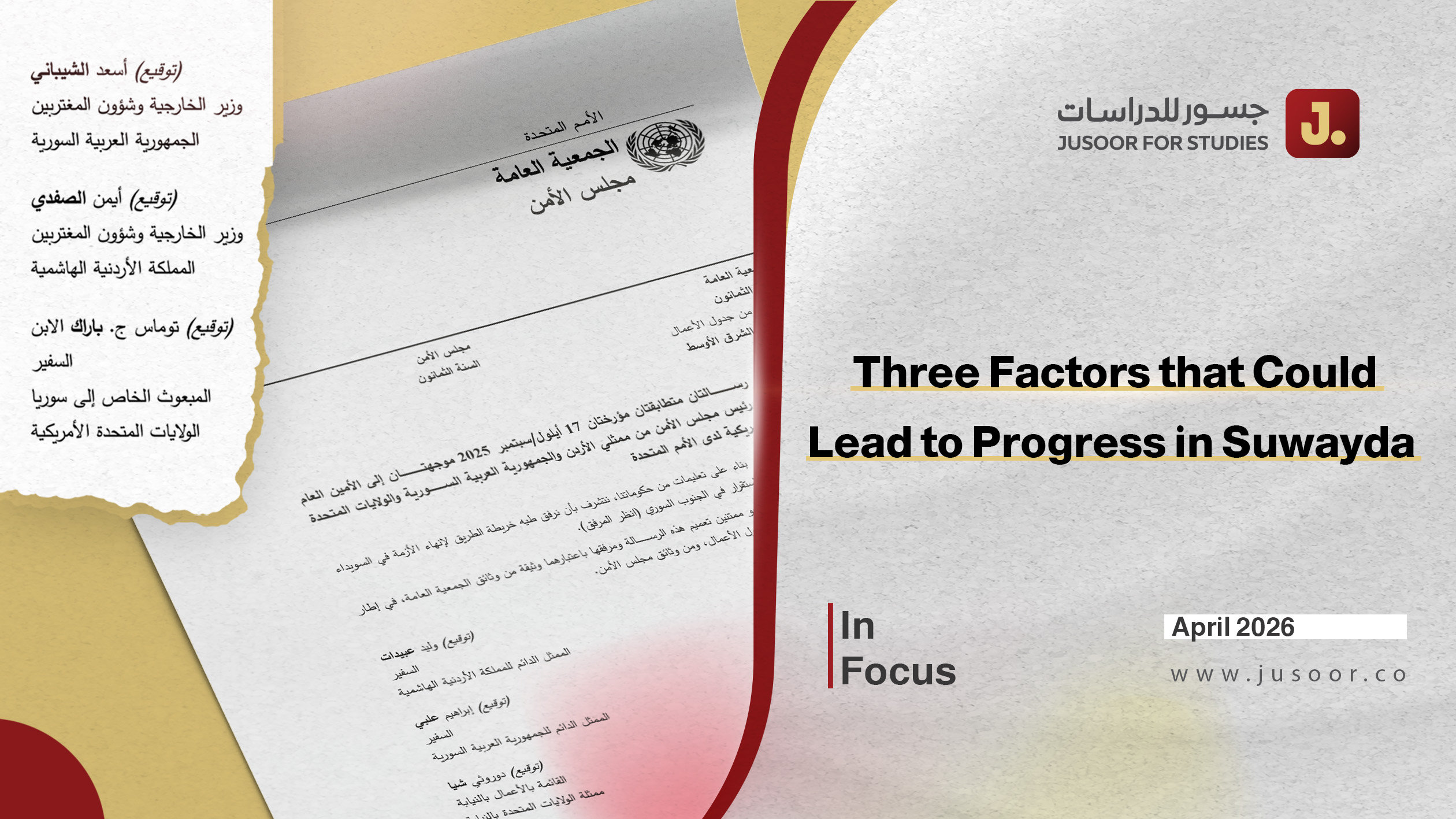
The Jordanian-American-mediated roadmap was signed in Damascus on September 16, 2025, following a wave of violence that had rocked the southern province the previous July, resulting in significant loss of life and damage to both private and public property.
While implementation has stalled, three new developments may give new impetus to the deal’s implementation. The first is that the Syrian government has managed—so far—to remain neutral in the American-Israeli war on Iran. For the first time in decades, Damascus has escaped the Iranian trap, under which Tehran had waged its battles outside Iranian territory, under the banner of the “axis of resistance.” In this regard, Assad-era Syria was a prominent arena, where the Islamic Republic deployed tens of thousands of affiliated militants, established hundreds of military bases and outposts, and used the country as a conduit for smuggling weapons to Hezbollah, its main ally in the region.
Since the beginning of the war in February, Iran has attempted to regain some of its influence in Syria and reignite chaos there. However, the Syrian government has thwarted these efforts, and confirmed to the international community—and particularly to neighboring states—that it has disengaged from this axis on a fundamental level, showing a sincere desire to cooperate in establishing peace and stability in the region.
By doing so, Syria is fulfilling one of the most important international demands placed upon it after the fall of the Assad regime. This could lead to more international support for Damascus, as well as reviving talks with Israel and strengthening the chances of reaching a Syrian-Israeli security agreement. In turn, this could lead Israel to pare back its public support for the forces controlling Suwayda, which may then compel them to reconsider their position, accept the roadmap and work with Damascus on implementing it.
The second development concerns the Lebanese government. Despite Beirut’s valiant effort to remain neutral, Hezbollah dragged the country into the U.S.-Israeli-Iranian war, under pressure from Tehran, sparking a brutal Israeli offensive into southern Lebanon. However, after Iran and the U.S. reached a ceasefire agreement that excluded Lebanon, the Lebanese government decided to open direct negotiations with Israel for the first time in its history.
This also amounts to the first moves by Lebanon to escape the Iranian trap, and strengthens the Lebanese government’s leverage as it seeks to disarm Hezbollah and integrate its fighters into the Lebanese army. Furthermore, it enhances the government’s chances of reaching a security agreement over southern Lebanon, or even a peace agreement, with Arab support and U.S. sponsorship. This reinforces Israel’s interest in stabilizing the situation in Syria, particularly in Suwayda, and in integrating armed groups into the Syrian army.
The third development is the successful implementation of a similar agreement between the Syrian government and the Syrian Democratic Forces (SDF), which has made significant gains from the deal. These include the prerogatives of appointing a governor and a Deputy Minister of Defense, their integration into the Syrian army while keeping their own formations intact, control over security matters and government services in their areas, and their imminent acquisition of seats in the People’s Assembly. All this is in addition to other gains for Syrian Kurds in general, such as a decree on citizenship, and the recognition of numerous rights denied to them by the former regime.
This example should offer a major incentive for the Druze component to pressure forces that oppose the implementation of the roadmap to come to the negotiating table, as the SDF has done. The path remains open for them to obtain similar gains to those achieved by the SDF—and which, in fact, meet the demands of the people of Suwayda.
In conclusion, the time appears ripe for forces on the ground in Suwayda to announce their acceptance of the roadmap and to engage seriously in negotiations with the Syrian government, which is expected to respond positively. Damascus, meanwhile, is establishing a consistent track record of enhancing stability and preventing a recurrence of conflict.